At the core, the fear of being seen is the fear that you're going to be judged harshly. Judged for looking stupid, for making a mistake, for sharing too much. And for women in particular, that's not an unreasonable fear.
But here's the thing. There's so much noise in the world that just because you're really good at something doesn't mean everybody's going to find out about it. Not unless you tell people. So you’ve got to be visible. And you can do it in a way that's not sleazy, not spammy, not yucky.
I see so many really talented coaches, healers and entrepreneurs who don't have full practices because they're uncomfortable letting people know they even exist. I think we all have that sleazy salesperson in our mind, the one we've dealt with at some point in our lives. We think, “I don't want to be that person,” so we go too far the other way.
And it's not just entrepreneurs. If you're in corporate, just because you sit down and do good work doesn't mean the higher-ups are going to notice you and promote you. Visibility matters everywhere: in a job interview, on the PTA, even in your own family. The challenge is the balancing act. How do you get visible and still be yourself?
I recently talked about exactly this with therapist Kim McLaughlin on her Feed Your Soul with Kim podcast. (Kim was also a guest on my podcast, The Courage to Be Visible, where we talked about being uncomfortable in your body and how that can hold you back.) You can watch our full conversation below, and keep reading for the big ideas.
Kim’s episode: https://youtu.be/76C26fFXEss?si=fhUAU1w-N9ukvq0M
What are we really afraid of?
There are a bunch of things wrapped up in the fear of being seen, but judgment sits at the centre of it. And we need to acknowledge that women are judged differently than men. So that fear of looking stupid or saying the wrong thing has real roots.
For me, those roots go back to school. I was the A student, and you got bullied for being a good student. If you raised your hand, if you showed off how much you knew, you'd get beat up. Not physically in my case, but emotionally. So for a lot of years I really tried to be invisible.
It took a long time for me to grow up and say, “You know what? I'm good at what I do. I'm going to tell people, and if somebody doesn't like it, I'm not for them.”
There's also a feeling of losing control. Once you put yourself out there, you can't control the narrative of how people see you. But here's what I'd remind you: there are probably people talking about you already that you don't know about. If you don't step up and steer the conversation, you have no control over it at all. You can't control what people hear when you say something. But if you say nothing, they're only hearing the other voices.
Another thing to consider is that most people aren’t judging you as harshly as you judge yourself. When I was in school I thought of myself as a painfully shy, nerdy bookworm. I recently ran into a classmate who thought I was an audacious wild child.
Self-worth and the willingness to be seen
Self-worth is a huge part of this. I've been in business for 20 years, and 20 years ago it was a lot harder for me to stand up, offer my services and talk to people. I was new, and I genuinely didn't have the confidence.
If you don't have confidence in yourself, it feels like you're lying when you tell people you're good at what you do. And for the record, nobody is fully confident all the time. Unless you're a sociopath.
Now that I've been at this for decades, I know my strengths and I know my weaknesses. When I have those moments where my brain says, “Andrea, you're crap,” I can stop and say, “Wait a sec. I've helped this person, and this person. I'm not actually crap.”
Kim had a great piece of advice here: tell people the part you actually believe about yourself. Don't make up the other part. The more you share what you truly believe, the more you start to see yourself differently.
“Can I learn this?” vs. “Have I done this before?”
When I was in my early 20s, a friend who ran a headhunting business with her husband told me something I've kept in the back of my mind ever since. She said that when men look at a job description, they ask, “Can I learn this? Can I figure it out?” When women look at the same job description, they ask, “Have I ever done this before?”
That's the difference between getting ahead and not. How do you grow if you only do things you've already done?
Nobody knows how to do everything. The real question is: Is this something I could learn? Could I hire somebody, take a course, read a book, or use ChatGPT to figure it out? Over the years you learn that you've figured out new things before, and it worked out okay. Confidence grows from that balance of experience and trying.
The day I met “fake Andrea”
I'll be honest. Even though I teach people how to show up on video, I didn't start out confident on camera either.
Back in 2018, when I first started taking video seriously, I found the whole process painful. And somewhere along the way, without even realizing it, I developed a “fake Andrea voice.” Remember the old Mary Tyler Moore Show? Ted Baxter had this deep voice he used on camera. I think I was channeling that character.
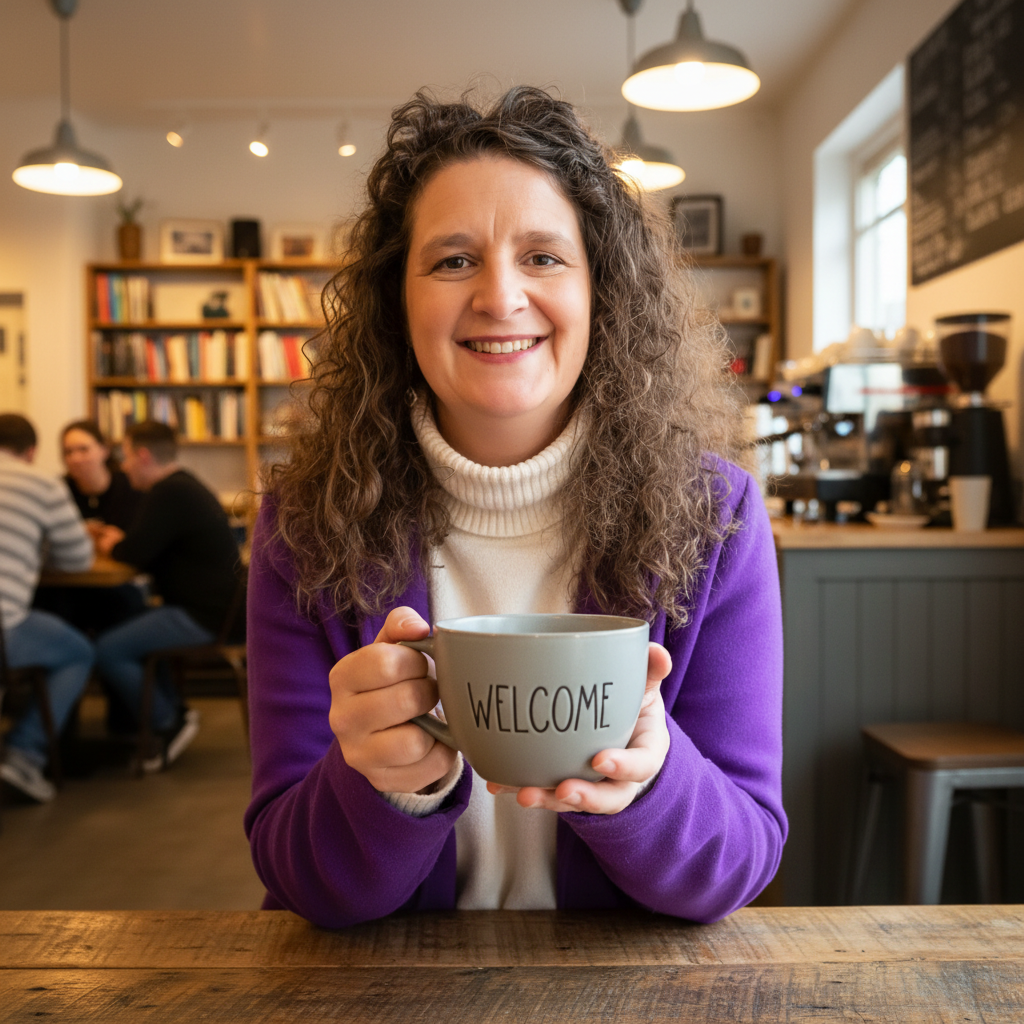
I didn't do it on purpose. It was an unconscious performance of who I thought I should be on video, instead of just being myself.
But when I watched the replay, it was a little horrific.
Here's what I realized. Fake Andrea wasn't protecting me. She was getting in the way. The people watching weren't connecting with me, because I wasn't really there. And the effort of performing was exactly what made video feel so painful.
When I let fake Andrea go and started talking to the camera the way I'd talk to a client over coffee, video got easier. Not perfect. Easier. And people responded to the real me in a way they never did to the performance.
So if you've ever watched yourself back and thought, “Who is that?” you're not alone. Confidence on camera doesn't come from getting better at performing. It comes from being willing to stop.
You're not for everyone (and that's perfectly okay)
Part of being visible is being okay with the fact that you're not for everyone.
I was reading a book recently (A Women’s Guide to Claiming Space by Eliza VanCort) about how women are raised to be nice girls, polite girls, friendly to everybody. We're supposed to be likable. So when somebody doesn't like you, or your offer, it feels like a personal failing.
But think of all the people you've met in your life. You don't like everybody. And it's not that they're bad people. Their interests are different from yours, or their style is different. There's a whole slew of reasons that have nothing to do with their worth as human beings. You just didn't hit it off.
It's taken me a long time to accept that I'm not for everyone, and that I shouldn't try to be. As Kim pointed out, when we try to please everybody, we aren't visible in an authentic way. People sense that, and it pushes them away, which makes us think we did something wrong. And then we don't want to be visible at all.
“How can I be visible if I don't know who I am?”
There was a period when my child was young that there was a whole swath of people in my town who probably didn't know my name. They knew me as Mom. Other people knew me as my husband's wife. Others knew me through the organization I volunteered for.
I felt like I didn't know who I was anymore. I was the mom, the wife, the volunteer. But who was I? That was a difficult time, and I had to rebuild my sense of who I am and who I want people to know me for.
I've had a bunch of conversations recently that tell me this is a common theme for women. When you're so busy focusing on everybody else, you forget who you are. And then you start a business and suddenly you're supposed to be visible, how can you do it when you don't know who you are?
What we see when we look in the mirror
Then there's physical appearance. I have a photo of me from when I was 17. A friend took it at the cottage. I'm in a bikini, and I distinctly remember thinking in that moment, “Oh my god, my thighs are so fat.” I look at that picture now and think, “I was this skinny, beautiful young girl!” Everybody looks beautiful at 17.
One of the joys of getting older is that I don't care about that stuff anymore. I've got a double chin. I don't like it, but I don't spend all day thinking about it. When somebody snaps a picture, I'm not thinking, “Don't look at my chin.” That took some work to get to.
How to stop spiralling when the camera turns on
When you're worrying about how you look and how you sound, it's because you're thinking about yourself. And when you think about yourself on camera, you get in that spiral where nothing's good enough.
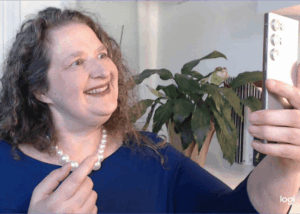
So here's what I do, and what I urge my clients to do. Think about that one person you can help. Think about the pain they're in and what they're struggling with. Think about how happy they'll be when they discover you're here to help them.
As soon as you start thinking about somebody else, so many of those fears go away. Because it's not about you anymore.
The Generous Experts I work with, the coaches and healers, didn't start a business because they wanted to get rich. They started because they had a burning desire to help people, and thought, “I can make money at this while I'm helping people.” That's why visibility is service. When you focus on helping one person, the fears never disappear completely, but that weight lifts off your chest.
Let them see you're human
In the professional world there's a push to sound like everything's perfect. But particularly for coaches, letting your clients know you're not perfect, that you've made mistakes and kept going, is inspirational.
One time, just after I hit record on a video, I sneezed. One of those massive, full-body sneezes that blows your socks off your feet. My first instinct was, “Nobody can see this.” Then I thought, “You know what? Everybody sneezes.” I kept it in. It was funny, and I got lots of comments from people saying, “Yep, I've done that too.” It's okay to be human.
And it works both ways. Kim talks about this in her therapy work: “when you share a little, and the other person shares a little, you both feel more connected. That's the know, like and trust factor. When someone is visible and a bit vulnerable with me, I think, I like her. I want her to be successful. I want other people to know about her.“
When nobody likes your post (or someone says something mean)
A lot of people pull back because a video didn't get likes, or nobody shared it. Suddenly being visible is about an end result you have no control over. Here's how I think about it.
You don't need to go viral
I had a video go viral once. Not millions of views, but 20 to 30 times my average. The vast majority of viewers were 18- to 24-year-old boys. They are never going to be my clients. I have no idea why they watched, unless they were looking for a mom.
If you're looking for three new clients, you don't need a million people to see your video. Thirty of your ideal clients is much more valuable than a million 18- to 24-year-old boys.
Silence doesn't mean nobody's watching
A client of mine was getting frustrated because nobody was commenting on her videos, even though her analytics showed people were watching. Then she was out in the community, and people started coming up to her saying, “Oh, I saw your video!”
Back in the chat room days, we called them lurkers. They read everything, but they never comment or engage. That doesn't mean they aren't getting value. And if you're a therapist or a healer, your people may not want the world to know they're interested in therapy or have health problems. They won't comment, but they may watch everything you do.
Have a plan for the negative stuff
Some people seem to have made it their whole purpose in life to say mean things to others on social media. I saw this up close when I ran a workshop for a local organization encouraging women to get involved in politics. Some of the things people said to those women politicians were shocking.
My advice to them: find a thick-skinned volunteer on your team to read all the comments. Have them flag only what you need to see, like a real question, a kind word, or someone offering to volunteer. And tell them never to pass along the nasty stuff. A lot of it is mean, but it's also stupid and pointless.
For most business owners, it doesn't get that bad. I put videos everywhere and I don't get many negative comments. When someone says something inappropriate or gratuitously mean, I've gotten very aggressive about blocking. I want people to feel good after spending time with me and my content, and I don't want my audience seeing that negativity either.
How people react has very little to do with you
Back in 2020, when lockdown hit and everyone's business went sideways, I was cold calling organizations to offer virtual workshops. One woman acted like I was a criminal for daring to charge money for my expertise.
In my 20s, that would have had me in the fetal position on the floor, crying and second-guessing myself. But I had a goal of 10 calls a day, no matter the response. So I picked up the phone again.
The very next person didn't know me from a hole in the ground. I told her about my workshops and the price, and she booked all four on the spot. She didn't book one to see if I was any good. She booked them all and didn't bat an eye.
Same offer. Same type of organization. Two different people. That was the moment I realized how people react to my offer has very little to do with me. Now when someone reacts negatively, I think back to those two women and remember: it's not always about me.
Kim added two great ideas here. Keep a memory of the times it worked, so you have evidence when the doubt creeps in. And have your person, someone you can call and say, “They said this nasty thing and I don't like it,” so you get support instead of spiralling alone.
Keep a file of complimentary emails, screen shots of supportive social media comments, testimonials. On bad days, this proof of your worth will keep you going.
What becomes possible when you stop hiding
I have a client who really did not want to do video. She didn't want to post on social media. She didn't want to do any of it. After working together, she started posting, and finally, after pulling some teeth, I got her doing videos.
And now? She's getting invited to speak at summits, on bigger and bigger podcasts, and in people's private groups. People are booking calls to talk about working with her. She has the same level of expertise she had before, and it's a lot. This woman is well educated, experienced, and full of great ideas. She just wasn't getting out there.
Now she says, “Oh my goodness, this is so much easier. Why was I letting myself struggle by not being visible?”
I see the same thing in my own business. When somebody gets on a call with me to talk about becoming a client, and they've already watched my videos and seen my posts, they feel like they know me, even if it's the first time we've met. It's like talking to somebody you've known for a while. The conversation feels relaxed. It doesn't feel forced or fake. It's just two people having a conversation, and it's so much more fun.
That's the expert who grows. Not the one with the best answer, but the one who is actually visible.
How I refill after putting myself out there
Being visible is vulnerable, and as an introvert, it takes something out of me. So almost every day, even in the winter when it's really cold, I go for a walk.
I live four blocks from the shores of Georgian Bay. On a recent walk I saw swans, a turkey vulture, hawks and Canada geese. There's an older couple who walk their dog at about the same time I do. I don't even know their names, but we say hi every morning.
It's my time to slow down and look at nature. I'm not working. I'm not looking after my elderly parents, or my child, or the house. It's just for me, and it costs nothing but a little time.
Early in my business, I'd sometimes get my head down and work. At one point I looked up and realized I hadn't stepped outside my house in four days. That was the moment I said, “This is not healthy.” My walk is only three kilometres. I'm not running a marathon. But it gets me moving, and every time I spot a different animal, it brings me joy.
If you want to be more visible, build in the things that refill you too.
Not sure what to say on video?
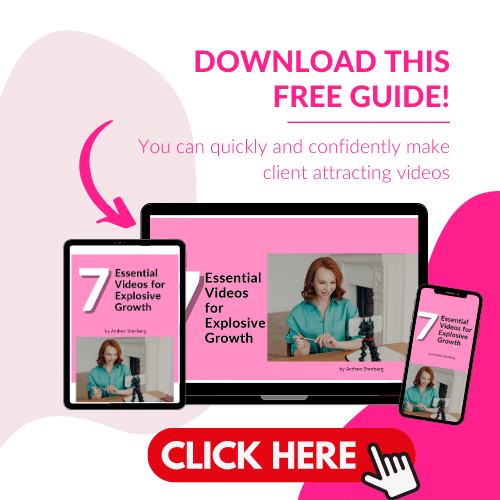
If you know you want to make videos for your business (or even your corporate career) but you're stuck on what to say, grab my free guide, Seven Essential Videos for Explosive Growth. It gives you seven videos you can make, and what to say in each one.